Gunning Manipulators for Refractory Materials: Design, Applications, and Technological Advancements
Refractory materials play a pivotal role in industries where high-temperature environments are inherent, such as metallurgy, cement production, glass manufacturing, and petrochemical processing. These materials provide thermal insulation and structural integrity to industrial furnaces, kilns, and reactors, ensuring operational safety and efficiency. The installation and maintenance of refractory linings, however, pose significant challenges due to the harsh working conditions and the need for precise material placement. Gunning manipulators have emerged as indispensable equipment in this domain, enabling efficient, accurate, and safe refractory gunning operations. This article explores the design principles, core components, key applications, technological innovations, and future trends of gunning manipulators for refractory materials.
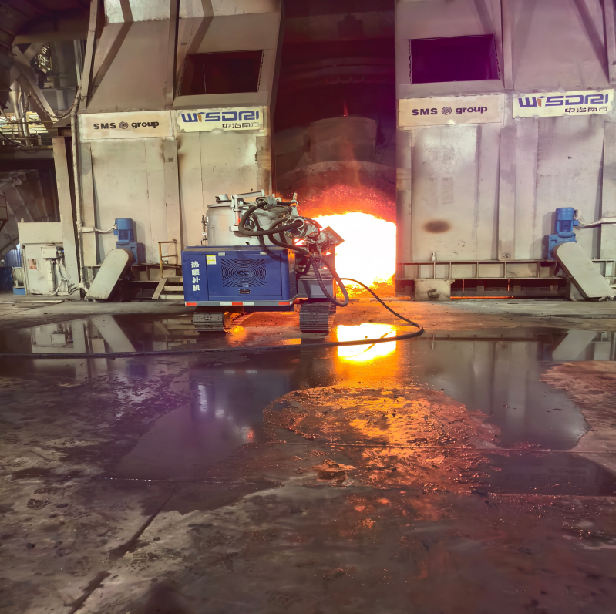
1. Overview of Refractory Gunning Technology
Refractory gunning is a process that involves projecting a mixture of refractory aggregates, binders, and water (or other liquid carriers) onto a target surface at high velocity to form a dense, homogeneous lining. Compared to traditional casting or ramming methods, gunning offers several advantages: faster construction speed, better adaptability to complex-shaped surfaces, reduced material waste, and the ability to perform in-situ repairs without extensive shutdowns. Gunning manipulators are specialized mechanical systems designed to control the gunning nozzle’s position, orientation, and movement, ensuring that the refractory mixture is applied uniformly and with the required thickness.
The performance of a gunning operation is highly dependent on the manipulator’s precision and stability. In high-temperature industrial settings, manual gunning is not only labor-intensive and inefficient but also exposes workers to potential hazards such as heat radiation, dust, and structural collapses. Gunning manipulators address these issues by automating or semi-automating the gunning process, improving both operational safety and lining quality.
2. Design Principles and Core Components of Gunning Manipulators
The design of gunning manipulators is tailored to meet the specific requirements of refractory gunning, including high load-bearing capacity, precise motion control, resistance to high temperatures and dust, and adaptability to different industrial environments. The following are the key design principles and core components of typical gunning manipulators:
2.1 Design Principles
Ergonomics and Safety: Manipulators are designed to minimize operator fatigue and reduce exposure to hazardous conditions. For semi-automatic models, adjustable control panels and ergonomic handles are integrated to enhance operability.
Motion Precision: The manipulator must achieve precise positioning of the gunning nozzle to ensure uniform lining thickness. This requires high-precision transmission systems and motion control algorithms to eliminate errors caused by mechanical backlash or external disturbances.
Environmental Adaptability: Components in contact with high temperatures or dust are made of heat-resistant and wear-resistant materials, such as high-grade steel alloys or ceramic coatings. Sealing systems are also employed to prevent dust ingress into mechanical and electrical parts.
Load-Bearing Capacity: The manipulator must support the weight of the gunning nozzle, hose, and the refractory mixture passing through the system. The structural frame is designed to withstand dynamic loads during operation to avoid deformation or instability.
2.2 Core Components
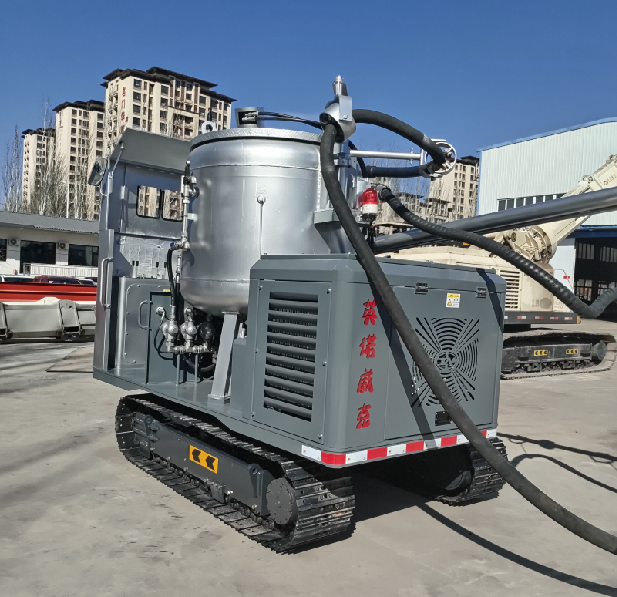
Structural Frame: The backbone of the manipulator, typically composed of heavy-duty steel profiles. It provides support for all other components and determines the manipulator’s working range. Frames can be fixed (for stationary furnaces) or mobile (equipped with wheels or tracks for large-scale facilities).
Motion Control System: This includes joints, actuators, and transmission mechanisms that enable multi-degree-of-freedom (DoF) movement of the gunning nozzle. Common joint types include revolute joints (for rotation) and prismatic joints (for linear movement). Actuators are usually hydraulic or pneumatic, as they offer high torque and load capacity, suitable for heavy-duty operations. For high-precision applications, electric actuators with servo motors are increasingly adopted.
Gunning Nozzle and Hose Assembly: The nozzle is responsible for accelerating the refractory mixture and directing it onto the target surface. Its design (e.g., diameter, shape, and spray angle) affects the spray pattern and lining density. The hose connects the nozzle to the refractory supply system and must be flexible enough to follow the manipulator’s movement while withstanding high pressure and abrasive materials.
Control System: The "brain" of the manipulator, which regulates motion, gunning pressure, and material flow. Semi-automatic manipulators are controlled by operators via a handheld pendant or control panel, while fully automatic models integrate programmable logic controllers (PLCs) and human-machine interfaces (HMIs) to execute pre-set gunning programs. Advanced systems may also include sensors for real-time monitoring of lining thickness and surface temperature.
Cooling and Dust Removal Systems: To ensure long-term operation in high-temperature environments, cooling systems (e.g., water-cooled jackets) are installed around key components such as the nozzle and actuators. Dust removal systems, such as suction hoods, are also integrated to reduce air pollution and protect the manipulator’s mechanical parts.

3. Key Applications of Gunning Manipulators in Industrial Sectors
Gunning manipulators are widely used in various industries that rely on refractory linings. Their applications vary based on the type of furnace/kiln, refractory material, and operational requirements. The following are the most prominent application sectors:
3.1 Metallurgical Industry
The metallurgical industry (including iron and steel, non-ferrous metals) is the largest consumer of refractory materials. Gunning manipulators are extensively used in the maintenance and repair of blast furnaces, converters, electric arc furnaces (EAFs), and ladles. For example, in blast furnace operations, the hearth and bosh regions are prone to erosion due to high-temperature molten iron and slag. Gunning manipulators equipped with long-reach arms can access these hard-to-reach areas to apply refractory mixtures, extending the furnace’s service life. In converters, manipulators are used to repair the lining during short shutdowns, reducing production downtime.
3.2 Cement Industry
Cement kilns operate at temperatures exceeding 1450°C, and their refractory linings are subjected to severe thermal shock and chemical corrosion. Gunning manipulators are used to apply refractory linings in the kiln shell, burning zone, and preheater towers. Mobile manipulators with flexible arms are particularly suitable for cement kilns, as they can adapt to the kiln’s cylindrical shape and perform continuous gunning during partial shutdowns.
3.3 Glass Manufacturing Industry
Glass melting furnaces require high-quality refractory linings to maintain stable temperatures and prevent contamination of the glass melt. Gunning manipulators are used to repair the furnace’s crown, sidewalls, and throat regions. Due to the strict requirements for lining uniformity in glass furnaces, manipulators with high-precision motion control systems are preferred. Some advanced models also integrate 3D scanning technology to map the furnace’s internal surface and optimize the gunning path.
3.4 Petrochemical Industry
In petrochemical plants, refractory linings are used in reactors, reformers, and cracking furnaces. These linings are exposed to high temperatures and corrosive gases, requiring frequent maintenance. Gunning manipulators with explosion-proof designs are used in these hazardous environments to ensure safe operation. The manipulators are often equipped with remote control systems, allowing operators to control the gunning process from a safe distance.
4. Technological Innovations in Gunning Manipulators
In recent years, driven by the demand for higher efficiency, better quality, and safer operations, gunning manipulators have undergone significant technological innovations. The following are the key advancements:
4.1 Automation and Intelligence
The shift from semi-automatic to fully automatic manipulators is a major trend. Modern gunning manipulators integrate PLCs, servo control systems, and machine vision technology to achieve autonomous operation. For example, 3D laser scanners or cameras are used to capture the target surface’s geometry, and the control system generates an optimal gunning path based on the scanned data. This not only improves lining uniformity but also reduces human error. Some advanced models can even adjust gunning pressure and material flow in real-time based on feedback from sensors that monitor lining thickness and density.
4.2 Robotics Integration
Industrial robots are increasingly being used as the core motion platform for gunning manipulators. Robotic manipulators offer higher flexibility and precision compared to traditional mechanical manipulators, with up to 6 or 7 DoFs, enabling them to reach complex-shaped surfaces (e.g., curved furnace walls or irregularly shaped reactors). Collaborative robots (cobots) are also being explored for small-scale gunning operations, as they can work safely alongside human operators without the need for heavy safety barriers.
4.3 Lightweight and High-Strength Materials
The use of lightweight and high-strength materials, such as aluminum alloys and carbon fiber composites, has reduced the manipulator’s overall weight while maintaining its load-bearing capacity. This not only improves the manipulator’s mobility (especially for mobile models) but also reduces energy consumption. Heat-resistant composites are also used in components exposed to high temperatures, extending their service life.
4.4 Remote Monitoring and Predictive Maintenance
Internet of Things (IoT) technology has been integrated into gunning manipulators to enable remote monitoring and predictive maintenance. Sensors installed on key components (e.g., actuators, hoses, and nozzles) collect data on temperature, pressure, vibration, and wear. This data is transmitted to a cloud-based platform, where it is analyzed to detect potential faults (e.g., hose leakage or actuator wear) before they cause downtime. Operators can also monitor the gunning process in real-time from remote locations, improving operational efficiency.
5. Challenges and Future Trends
Despite the significant advancements in gunning manipulator technology, several challenges remain. One of the main challenges is adapting to the increasing diversity of refractory materials, such as low-cement refractory, ultra-low-cement refractory, and ceramic fiber-reinforced refractory. Different refractory materials have different flow properties and gunning requirements, requiring manipulators to have adjustable parameters (e.g., gunning pressure, nozzle speed) to ensure optimal application. Another challenge is operating in extremely harsh environments, such as high-temperature, high-dust, or explosive environments, which requires further improvements in component durability and safety.
Looking ahead, the development of gunning manipulators for refractory materials will focus on the following trends: (1) Further integration of artificial intelligence (AI) and machine learning (ML) to enable adaptive gunning—adjusting parameters based on real-time material and environmental data. (2) The use of digital twins to simulate the gunning process, allowing operators to optimize gunning paths and parameters before on-site operation. (3) Increased miniaturization of manipulators to access narrow spaces in complex industrial equipment. (4) The development of eco-friendly manipulators with reduced energy consumption and waste generation, aligning with global sustainability goals.

6. Conclusion
Gunning manipulators have become a critical technology in the installation and maintenance of refractory linings, significantly improving operational efficiency, safety, and lining quality across various high-temperature industries. Their design, which emphasizes precision, environmental adaptability, and load-bearing capacity, has evolved with technological advancements—from semi-automatic mechanical systems to fully automatic, intelligent robotic platforms integrated with IoT and AI. As industries continue to demand higher performance and sustainability, gunning manipulators will undergo further innovations, addressing challenges such as material diversity and harsh environment operation. In the future, these manipulators will play an even more vital role in ensuring the reliability and efficiency of high-temperature industrial processes, supporting global industrial development and sustainability.


