Blade-integrated Reamer Bit: Design Innovations, Performance Optimization, and Field Applications
Abstract
Blade-integrated reamer bits have emerged as critical tools for precision hole finishing and formation enlargement across industries ranging from civil engineering to oil and gas drilling. By integrating cutting blades with the bit body or shank, these tools address longstanding challenges of torque loss, lateral force imbalance, and low efficiency in harsh machining environments. This article reviews the structural evolution of blade-integrated reamer bits, analyzes key design optimizations including blade geometry and cutter layout, presents performance validation through laboratory tests and field cases, and discusses future development trends.
1. Introduction
Reaming operations demand tools that deliver both dimensional accuracy and structural durability, particularly when working with high-strength materials or complex formations. Traditional split-type reamers suffer from torque dissipation at the blade-shank interface and poor dynamic balance, limiting their application in high-precision machining or hard-rock drilling . Blade-integrated designs mitigate these issues by forming a monolithic structure of cutting blades, support components, and shanks. This integration not only enhances torque transmission efficiency but also enables advanced actuation mechanisms for variable-diameter reaming .
The scope of blade-integrated reamers has expanded beyond conventional mechanical processing to specialized fields: from planting hole excavation in rocky abandoned mine areas to dolerite formation drilling in oilfields . Their adaptability stems from two core advantages: structural integrity that reduces non-productive time (NPT) from tool failure, and modular blade design that accommodates application-specific requirements.
2. Structural Design and Key Innovations
2.1 Monolithic Integration and Torque Transmission
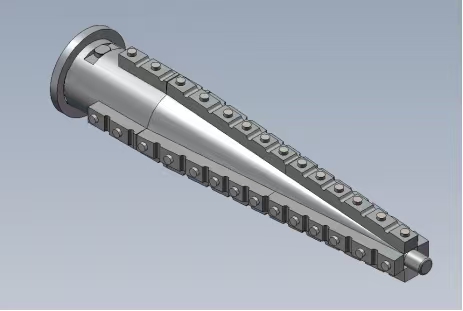
A typical blade-integrated reamer bit consists of three integrated components: the cutting blade assembly, a flat support section, and a shank . The one-piece construction eliminates mechanical joints between the blade and shank, ensuring 100% torque transfer from the machine tool to the cutting teeth. Laboratory tests confirm that this design achieves dynamic balance errors below 0.02 mm, meeting the precision requirements of aerospace and mold manufacturing .
For downhole applications, integration extends to actuation systems. In lateral reamers developed for rocky mine rehabilitation, two cambered PDC blades are mounted symmetrically within the bit body via rotation joints . A screw-driven actuation mechanism and spatial double-triangle transmission system control blade deployment, enabling reaming diameters from 240 mm to 407 mm in concrete samples .
2.2 Blade Geometry Optimization
Blade shape directly impacts cutting load distribution and hole quality. Traditional straight blades concentrate 60-70% of the cutting force on the leading 30% of teeth, leading to premature wear . By contrast, cambered blades with specially defined curves distribute 85.7% of the reaming load across the entire blade surface . This geometry evolution is validated by indoor tests: when reaming concrete with a cambered blade prototype, average cutting resistance decreased by 18% compared to straight-blade designs .
In civil engineering foundation drilling, metamorphic triangle blades have proven effective for forming conical stake holes. The hypotenuse-mounted teeth of these blades create a tapered profile while maintaining stable cutting forces in rocky formations . For hard-rock oil drilling, conical diamond elements with thicker diamond tables enhance impact resistance—critical for formations with unconfined compressive strength (UCS) up to 310 MPa .
2.3 Cutter Layout and Lateral Force Balance
Uneven force distribution on blades generates lateral vibrations, degrading wellbore quality and reducing tool lifespan . The zoning method addresses this by dividing the reamer’s 360° rotation into discrete cutting stages, each optimized with specific cutter back rake angles. Using the NSGA-Ⅱ genetic algorithm, researchers established a multi-objective optimization model targeting minimum lateral force across all stages .
Application of this model to a three-blade reamer reduced lateral force variation by 42%, with the ratio of lateral force to weight on bit (WOB) maintained below 5% . This balance minimizes drill string vibration and extends bit run life in extended-reach wells.
2.4 Auxiliary Functional Integration
Modern blade-integrated reamers incorporate additional features to enhance performance:
3. Performance Validation: Laboratory and Field Results
3.1 Laboratory Testing
Indoor experiments on lateral reamer prototypes demonstrate their capabilities in hard materials:
3.2 Field Applications
3.2.1 Rocky Mine Vegetation Restoration
In China’s karst abandoned mine areas, traditional diggers fail to penetrate rock-dominated terrain. A blade-integrated lateral reamer bit, combining PDC technology and metamorphic mechanisms, successfully excavated 500+ planting holes (diameter 350-400 mm) in granite formations . The tool eliminated the need for pre-blasting, reducing hole excavation time by 67% and lowering project costs by $12,000 per hectare.
3.2.2 Oilfield Hard Formation Drilling
The Kahlouche Field in Algeria presents extreme challenges with dolerite inclusions (UCS 310 MPa) that historically damaged conventional PDC bits . Schlumberger’s StingBlade™ integrated reamer, featuring conical diamond elements, drilled 477 m in one run—including a 28 m dolerite section—without bit replacement. This achievement saved 30+ hours of rig time and reduced costs by $306,000 .
3.2.3 Precision Machining
A tool-handle integrated step-blade reamer was deployed in automotive engine block manufacturing. Its monolithic structure and multi-stage blades finished 12 mm to 25 mm holes in aluminum alloy with tolerance ±0.005 mm, reducing tool change frequency by 80% compared to split-type reamers .
4. Challenges and Future Directions
Despite advancements, blade-integrated reamers face two key challenges:
Material limitations: PDC blades exhibit rapid wear in abrasive formations (e.g., sandstone with 20% quartz content). Developing diamond-enhanced carbide or cubic boron nitride (CBN) integrated blades could extend lifespan.
Real-time monitoring: Current designs lack in-situ sensors for blade wear and cutting force. Integrating IoT sensors with blade structures would enable predictive maintenance.
Future innovations will likely focus on three areas:
5. Conclusion
Blade-integrated reamer bits represent a paradigm shift in precision cutting and formation enlargement. Their monolithic structure eliminates torque loss, while optimized blade geometry and cutter layout balance cutting forces for enhanced durability. Field applications across mining, oil and gas, and manufacturing validate their ability to reduce costs and improve efficiency in harsh environments. As material science and digital control technologies advance, blade-integrated reamers will continue to expand their role in high-precision, high-reliability operations.


